
Home › Guides › Potty Training
How to Potty Train a Puppy Fast: A Simple Schedule That Works
Reader-supported: some links here are affiliate links.
Potty training is usually the first big project with a new puppy — and the one that causes the most stress (and carpet cleaner). The secret isn't a special trick. It's a predictable schedule, close supervision and rewarding the right spot every single time.
Here's exactly how to do it.
How long does potty training take?
Most puppies get the basics in a few weeks, but being fully reliable — no accidents, holding it through the night — often takes until 4 to 6 months of age, sometimes longer for small breeds. Consistency in the first few weeks makes the biggest difference.
The "age + 1" rule for how long a puppy can hold it
A common rule of thumb: a puppy can hold their bladder for roughly their age in months plus one, in hours, while resting. A 2-month-old puppy might manage about 3 hours; a 3-month-old about 4 hours.
That's a maximum during quiet time, not a goal. When puppies are playing, eating or excited, they need to go much more often.
When to take your puppy outside
Take your puppy to their potty spot:
- First thing in the morning — carry young puppies if needed, so they don't go on the way
- Within 10–15 minutes after eating or drinking
- Right after waking from any nap
- During and after play (every 20–30 minutes of active play)
- After crate time
- Last thing before bed
A sample daily schedule (8–12 week old puppy)
| Time | Activity |
|---|---|
| 6:30 am | Wake up → straight outside |
| 7:00 am | Breakfast → outside 10–15 min later |
| 7:30–8:30 am | Play & short training → outside |
| 8:30–10:30 am | Nap in crate or pen |
| 10:30 am | Outside immediately after waking |
| 12:00 pm | Lunch → outside |
| 12:30–2:30 pm | Nap |
| 2:30 pm | Outside, play, outside again |
| 5:00 pm | Dinner → outside |
| 6–8 pm | Play, chew, potty breaks every 30–45 min |
| 9:30 pm | Water away about 1–2 hours before bed (check with your vet) |
| 10:30 pm | Final potty break → bed |
| Night | One or two quiet potty trips, depending on age |
Adjust the times to your life — what matters is the pattern.
Step 1: Pick one potty spot
Always take your puppy to the same area, on a leash, using the same door. The smell helps them understand what that spot is for.
Step 2: Stay boring until they go
Stand still and let your puppy sniff. Use a cue phrase like "go potty" in a calm voice. Avoid playing until after they've gone — otherwise outside becomes play time and they forget why they're there.
If nothing happens in about 5 minutes, go back in, keep your puppy in the crate or right next to you for 10–15 minutes, then try again.
Step 3: Reward immediately — outside
The moment your puppy finishes, praise warmly and give a tasty treat right there, within a second or two. Rewarding once you're back inside teaches your puppy that coming inside is the good thing, not peeing outside.
Keep a small treat pouch by the door so you never forget.
Step 4: Supervise or confine
Most accidents happen when no one is watching. Inside the house, your puppy should be:
- In view — use a leash tied to your waist or a baby gate to keep them in the same room, or
- In a crate or small pen — puppies naturally avoid soiling their sleeping area when the space is the right size
Watch for warning signs: sniffing the floor, circling, suddenly wandering away, or whining at the door. When you see them, calmly head outside.
Step 5: Handle accidents the right way
Accidents will happen. How you react matters:
- If you catch them in the act: calmly interrupt ("oops!"), scoop them up and take them outside. Reward if they finish there.
- If you find it later: just clean it up. Your puppy can't connect a punishment to something that happened even a minute ago.
- Never rub their nose in it or yell. It teaches your puppy to hide from you when they need to go — which makes potty training slower.
- Use an enzymatic cleaner. Regular cleaners can leave a scent that draws your puppy back to the same spot.
Night-time potty breaks
Young puppies usually can't make it through the night yet. Keep the crate near your bed so you hear them stir. Take them out on a leash, keep the lights low, no play and no talking beyond your potty cue, then straight back to bed. As your puppy grows, you can gradually stretch the time between night breaks.
What about puppy pads?
Pads can help if you live in an apartment high up or can't get outside often. The downside: they teach your puppy that it's OK to go indoors, so you'll eventually need to transition outside. If you use pads, keep them in one spot and gradually move them toward the door.
Potty training mistakes that cause more accidents
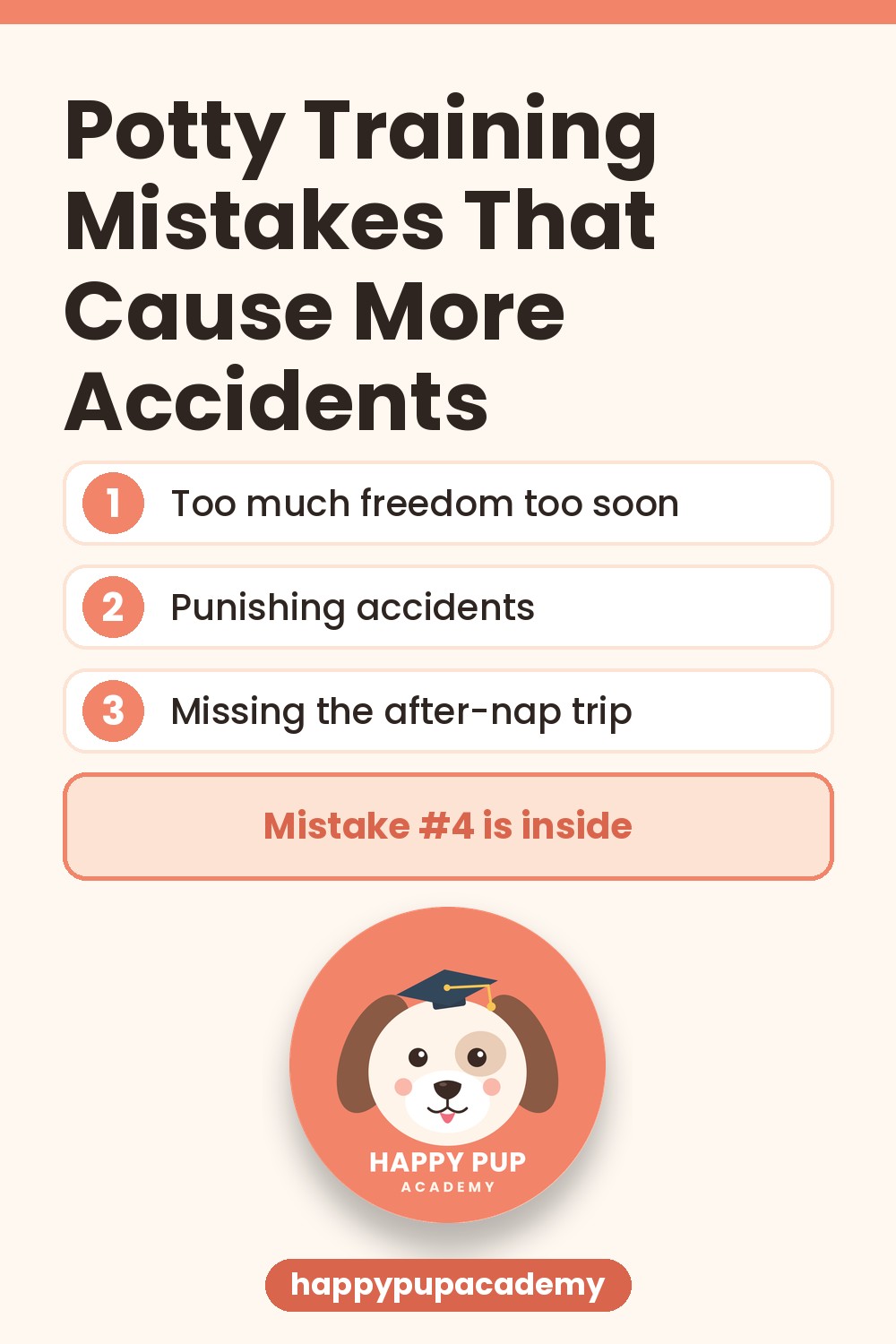
- Too much freedom too soon. A puppy who can wander the whole house will find a quiet corner to go. Keep the space small (a pen, a gated kitchen or a leash attached to you) and expand it room by room as the accident-free days add up.
- Punishing accidents. Scolding doesn't teach "go outside." It teaches "don't go in front of my human," so puppies start sneaking off to hide it. Calmly interrupt, take them out, and reward if they finish there.
- Missing the after-nap trip. Most puppies need to go within minutes of waking up. Carry them straight out the moment they open their eyes — before a single sniff of the rug.
- Cleaning with the wrong product. This is the one most owners miss. Ammonia-based cleaners smell like urine to a dog, so they can actually invite your puppy back to the same spot. Use an enzyme cleaner made for pet messes so the scent is truly gone.
- Stopping the routine too early. A good week doesn't mean the job is done. Keep the schedule for at least a month after the last accident.
Troubleshooting
- Peeing right after coming inside? Stay outside longer, and stay boring until they go.
- Accidents in one specific spot? Clean with an enzymatic cleaner and block access for a while.
- Sudden regression, peeing very often, or straining? Talk to your vet — urinary tract infections and other medical issues can cause accidents.
Want training that builds focus too?
Potty training gets much easier when your puppy can settle, focus on you and wait calmly. Short "brain games" during the day help with all three.
Want a done-for-you training plan?
Brain Training for Dogs walks you through 21 short games that build calm focus and good habits at home — a great companion to a solid potty schedule, using only positive reinforcement.
See Brain Training for Dogs →(affiliate link)
Quick recap
- Follow a predictable schedule built around eating, sleeping and play
- Use one potty spot and a calm cue phrase
- Reward immediately, outside
- Supervise or confine — no free-roaming yet
- Never punish accidents; clean with an enzymatic cleaner
- Plan quiet night-time breaks for young puppies
Stick with it for a few consistent weeks and you'll see a big difference.
FAQ
How often should a 10-week-old puppy go out?
Roughly every 1–2 hours while awake, plus right after eating, napping and playing.
Should I take water away at night?
Many owners remove water about 1–2 hours before bedtime. Make sure your puppy drinks plenty during the day, and check with your veterinarian, especially in hot weather.
My puppy was doing great and suddenly started having accidents. Why?
Regressions are common during growth spurts, changes in routine or excitement. Go back to more frequent breaks — and see your vet if you notice frequent peeing, straining or blood.
Free: The 7-Day Calm Puppy Plan
A printable one-page routine — what to do each day for biting, potty breaks, crate time and play. Get it free by email.
Sign-up opens soon.
Save this guide for later
Found this helpful? Save it on Pinterest so you can come back to it.