Home › Guides › Puppy Training
How to Stop Puppy Biting: 7 Gentle Steps That Actually Work
Reader-supported: some links here are affiliate links.
If your new puppy treats your hands like chew toys, you're not doing anything wrong — and your puppy isn't "bad." Nipping is one of the most normal puppy behaviors there is. The good news: with the right approach, most puppies learn a much softer mouth within a few weeks.
Below you'll find why puppies bite, the 7 steps that work, the common mistakes that make biting worse, and when to call a professional.
Why puppies bite (it's not aggression)
Puppies explore the world with their mouths the way babies explore with their hands. Biting is also how they play with littermates. In the litter, when one puppy bites too hard, the other yelps and stops playing. That's how puppies start learning bite inhibition — controlling the force of their jaws.
Other common reasons:
- Teething. Puppies lose their baby teeth and grow adult teeth roughly between 3 and 7 months of age. Sore gums make them want to chew everything.
- Over-tiredness. Many "piranha" moments happen when a puppy has been awake too long. Young puppies need a lot of sleep — often 16 to 20 hours a day.
- Play and excitement. Moving hands, feet and dangling sleeves are irresistible.
- Attention. If biting reliably makes you squeal and move, your puppy learns it's a great way to start a game.
The goal isn't zero mouthing on day one. First we teach your puppy to bite gently, then to stop putting teeth on people altogether.
Step 1: Always have a toy within reach
The fastest fix is redirection. Keep soft tug toys, rope toys and chews in every room (a basket by the couch works well). The moment your puppy starts mouthing you, calmly offer a toy and make the toy the exciting option: wiggle it along the floor, let your puppy "win" sometimes.
Long toys are best because they keep your fingers far from those needle teeth.
Step 2: Make biting end the fun — calmly
When teeth touch skin, the game stops. Say a neutral marker like "oops" in a normal voice, take your hands away and turn your body to the side for 10–20 seconds. Then invite play again with a toy.
If your puppy keeps chasing your hands or ankles, step behind a baby gate or into another room for 30 seconds. You're not punishing — you're simply showing that hard mouths make the fun disappear and gentle play keeps it going.
Step 3: Reward the moments your puppy chooses NOT to bite
Puppies repeat what gets rewarded. Catch your puppy licking your hand, sniffing calmly or chewing a toy, and quietly mark it with "yes!" followed by a small treat or praise. Many owners only react when the puppy is naughty — flip that around and pay for good choices.
Step 4: Protect sleep with a nap schedule
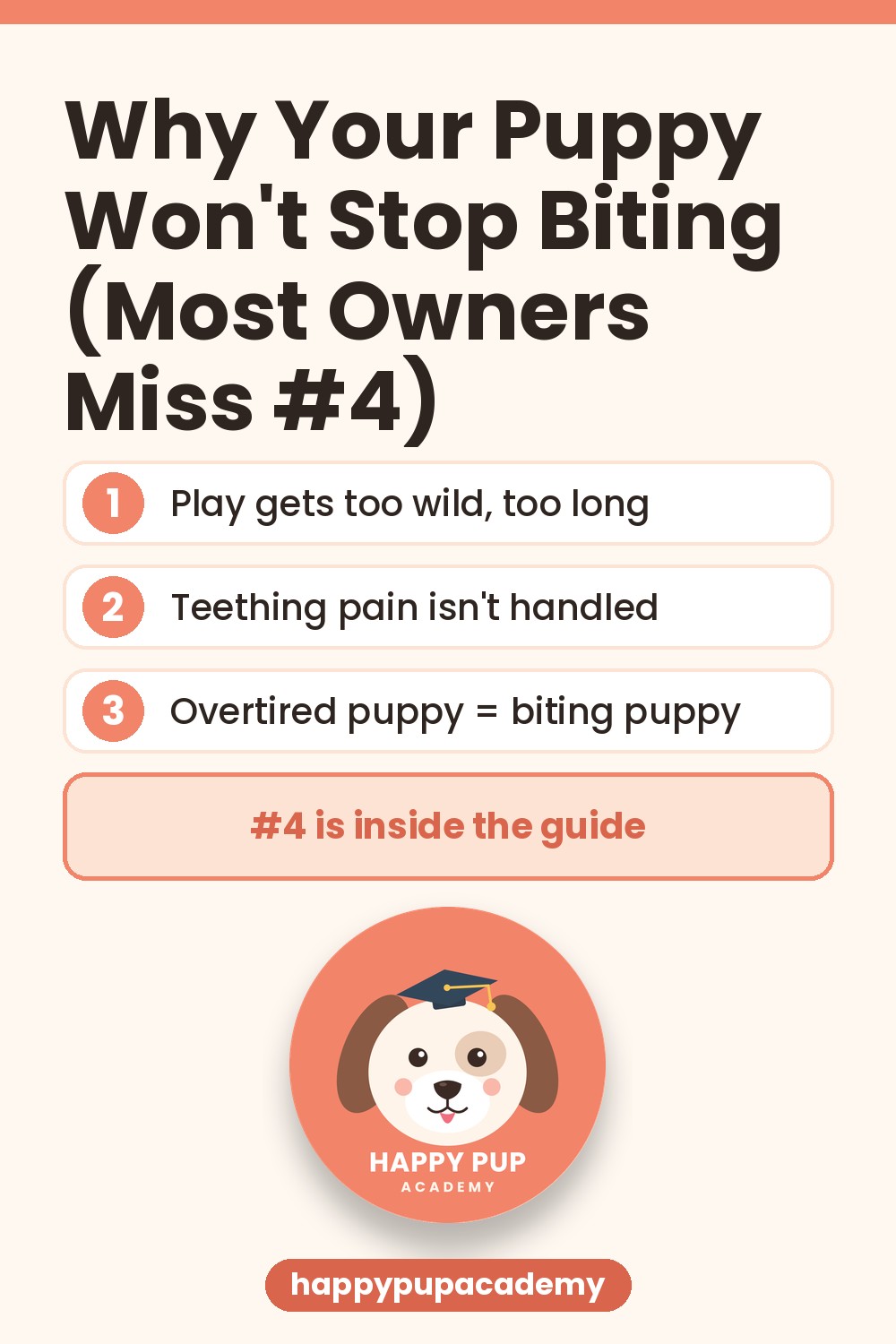
This step surprises most people, but it's often the biggest game-changer. If your puppy suddenly turns into a biting machine in the evening, there's a good chance they're over-tired.
A simple rhythm for young puppies:
| Time awake | What to do |
|---|---|
| 0–10 min | Potty break |
| 10–45 min | Play, short training, exploring |
| 45–60 min | Potty break, then quiet chew in crate or pen |
| 1–2 hours | Nap |
Treat that end-of-play nap as non-negotiable. A rested puppy bites far less.
Step 5: Give teeth a better job
Chewing is a real need, especially during teething. Rotate a few safe options so they stay interesting:
- A rubber food toy stuffed with part of a meal and frozen
- A damp washcloth twisted and frozen (always supervise)
- Puppy-safe chews appropriate for your puppy's size
A frozen stuffed toy in the crate or pen during "zoomie hour" can calm the whole household.
Step 6: Teach "leave it" and a gentle "take it"
Two short exercises build impulse control, which is really what bite inhibition is about.
- Gentle take it: Hold a treat in your closed fist. Ignore licking and nibbling. The moment your puppy backs off or softens, open your hand and say "take it." Repeat 5–10 times per session.
- Leave it: Show a treat in your open palm. If your puppy goes for it, close your hand. The instant they look away, mark "yes" and give a different treat from your other hand.
These games teach your puppy that calm self-control — not grabbing — is what pays off. If you want a complete structured version of games like these, the program we recommend below is built entirely around them.
Want a done-for-you training plan?
Brain Training for Dogs by certified trainer Adrienne Farricelli includes impulse-control games — like "leave it" and gentle "take it" — laid out step by step with videos, so you're never guessing what to practice next.
See Brain Training for Dogs →(affiliate link)
Step 7: Keep the whole family consistent
If one person plays rough "hand wrestling" games and everyone else says no, your puppy gets mixed messages. Agree on the rules:
- Toys only for play — no wrestling with hands
- Everyone uses the same marker words ("oops," "yes," "leave it")
- Kids play with long toys and step away (or behind a gate) when the puppy gets mouthy
- Young children should always be supervised with a puppy
Mistakes that make biting worse
- Yelling, tapping the nose or holding the mouth shut. These can scare your puppy, damage trust and sometimes increase biting. Physical punishment is not recommended by veterinary behavior experts.
- Pulling your hand away fast. Fast movement looks like prey. Freeze, then calmly remove your hands.
- Too much excitement right before bed. Wind down with a chew instead of a wild game.
- Expecting results in a day. Most puppies improve noticeably over 2–4 weeks of consistent practice.
How long does puppy biting last?
Mouthing usually peaks during teething and fades as adult teeth settle in, often by around 6–7 months — sooner with consistent training. If biting is getting harder or more frequent after that age, it's time to get help.
When to talk to a professional
Contact your veterinarian or a certified behavior professional if your puppy:
- Growls, stiffens or bites when you touch food, toys or their body
- Bites hard enough to break skin regularly
- Seems fearful, or bites when cornered or handled
- Is older than about 6 months and biting is increasing
These can be signs of fear, pain or other issues that need a professional, in-person plan.
Quick recap
- Keep toys within reach and redirect
- Calmly end play when teeth touch skin
- Reward calm, gentle choices
- Protect naps — over-tired puppies bite more
- Provide safe things to chew
- Practice "gentle take it" and "leave it"
- Get the whole family on the same page
Stay patient. Every gentle redirection teaches your puppy something — and the soft-mouthed adult dog you're building is worth it.
Want a done-for-you training plan?
If you want a complete, step-by-step program, Brain Training for Dogs by certified trainer Adrienne Farricelli uses 21 short games to build focus, impulse control and good manners — all with positive reinforcement you can do at home.
See Brain Training for Dogs →(affiliate link)
FAQ
Is it normal for an 8-week-old puppy to bite a lot?
Yes. Young puppies mouth constantly as part of play and exploration. Focus on redirection, naps and rewarding gentle behavior.
Should I let my puppy bite me gently?
In the early weeks, gentle mouthing that stops when you end play is part of learning bite inhibition. Gradually raise the bar until any teeth on skin ends the game.
Does yelping work?
For some puppies, a short "ouch" causes them to pause. For others it increases excitement. Watch your puppy's reaction and switch to calmly ending play if yelping makes things worse.
Free: The 7-Day Calm Puppy Plan
A printable one-page routine — what to do each day for biting, potty breaks, crate time and play. Get it free by email.
Sign-up opens soon.
Save this guide for later
Found this helpful? Save it on Pinterest so you can come back to it.